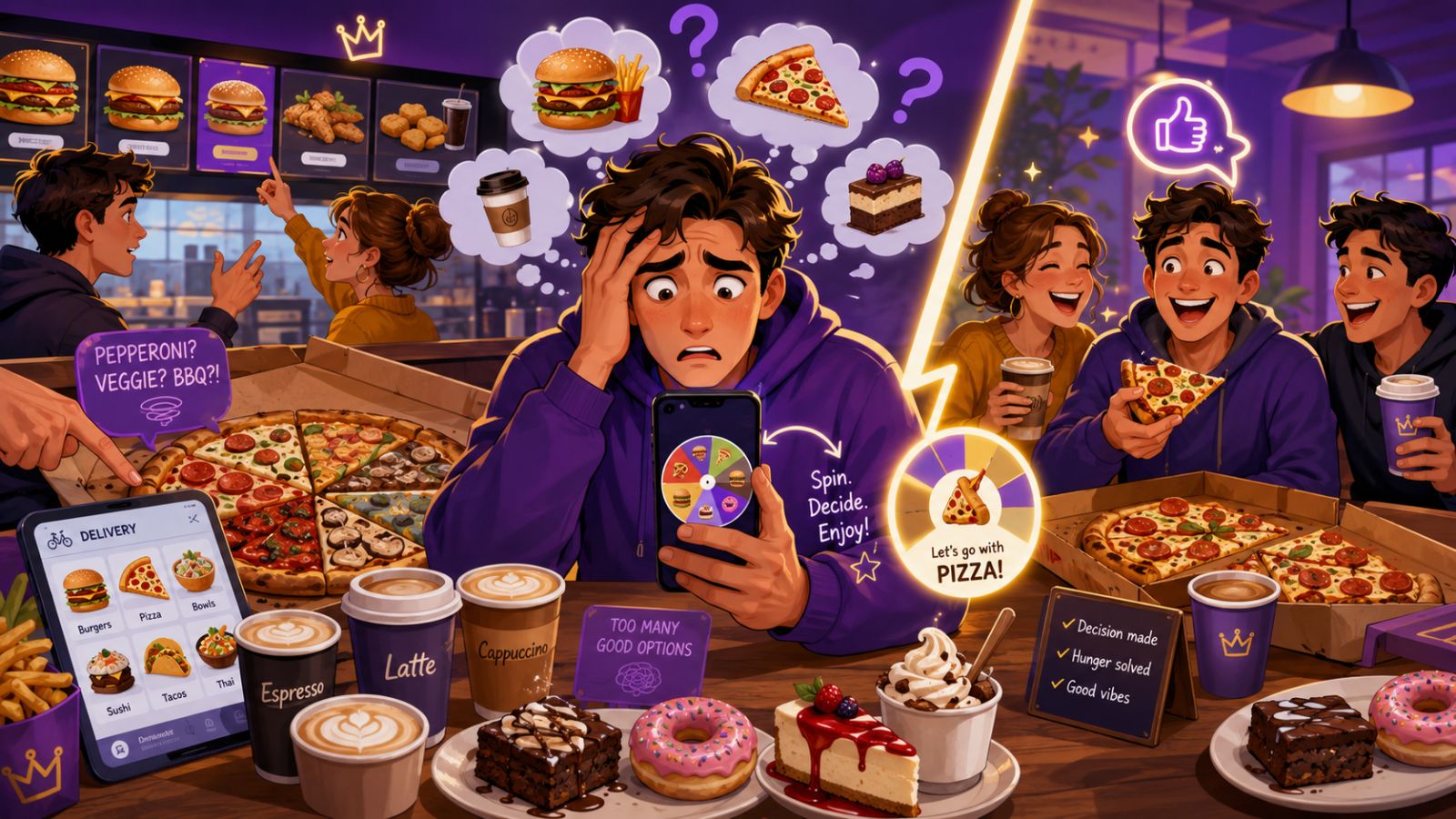

Have you ever spent fifteen minutes deciding what to eat, only to finish the meal in ten?
It happens more often than most people realize. Someone stands in a burger restaurant staring at the menu board. Another person scrolls through a food delivery app, opening and closing the same few restaurants repeatedly. A group of friends debates between two pizza places while everyone grows hungrier. Even a quick coffee run can turn into a surprisingly long decision.
Modern food culture gives us more choices than ever before. At first glance, that sounds like a good thing. More restaurants, more drinks, more cuisines, and more delivery options should make finding something enjoyable easier.
Yet many people experience the opposite. The sheer number of options can make simple food decisions feel unnecessarily difficult.
The Hidden Problem Behind Restaurant Menus
Restaurant menus have expanded dramatically over the years. What was once a straightforward selection of a few dishes can now become a booklet filled with appetizers, specialty items, seasonal offers, sides, desserts, and drink combinations.
While variety can be appealing, there is a point where additional options stop helping.
Psychologists often refer to this as choice overload. When people are presented with too many alternatives, the effort required to compare them increases. Instead of feeling empowered, they feel mentally tired.
A menu with fifty items may seem better than a menu with ten. In reality, many customers spend more time evaluating possibilities than enjoying the dining experience itself.
This is one reason some people use a restaurant decision helper when they cannot agree on where to eat. Reducing the number of possibilities often makes the decision easier than continuing to compare dozens of restaurants.
The goal is not always to find the perfect option. Sometimes it is simply to make a choice and move on.
Why Coffee Shops Create the Same Decision Problem
Coffee shops are another great example of getting tired of deciding.
At first, coffee sounds simple. Then the menu appears.
Should it be a latte, cappuccino, flat white, mocha, or cold brew? What size? What milk option? Hot or iced? Extra flavor or no flavor?
None of these decisions are particularly important on their own. Yet together they create a surprising amount of mental work.
Many coffee drinks are similar enough that the differences have little impact on overall satisfaction. However, customers often treat the choice as if selecting the wrong drink would somehow ruin the experience.
The result is unnecessary deliberation over options that are all reasonably good.
Some people solve this by using a coffee choice tool when they want something different but do not want to spend time comparing every possibility. It introduces variety without requiring endless analysis.
Interestingly, many people end up enjoying whatever they receive once the decision is made.
Pizza, Desserts, and the Endless Search for the Perfect Choice
Few foods make you more tired of choosing than pizza and desserts.
Consider pizza toppings. One person wants pepperoni. Another prefers vegetables. Someone else is tempted by a specialty pizza that looks interesting but unfamiliar. Delivery apps then add dozens of restaurants into the mix, each offering slight variations.
The same thing happens with desserts.
A restaurant menu might include cheesecake, brownies, ice cream, cookies, cake, and seasonal specials. Instead of immediately selecting something enjoyable, people often compare every option in search of the absolute best choice.
The irony is that many of these options would provide a perfectly satisfying experience.
The problem is not a lack of good choices. The problem is trying to identify a single ideal choice among many good ones.
That is why some people use a pizza decision wheel when debating dinner plans. Others rely on a dessert picker when every dessert sounds appealing.
The random element removes the pressure of optimization and allows people to move forward.
Why Random Decisions Sometimes Work Better
Not every decision deserves deep analysis.
This idea can feel uncomfortable because people often assume that more thinking leads to better outcomes. In some situations, that is true. Major financial decisions, career choices, and long term commitments benefit from careful evaluation.
Food choices are different.
If several restaurants are appealing, or if multiple desserts sound enjoyable, spending twenty minutes comparing them may provide little additional value.
Random selection works because it bypasses unnecessary comparison. It removes the need to rank every option and shifts attention toward action.
A useful random food choice approach does not claim to identify the objectively best meal. Instead, it helps people stop cycling through possibilities and start eating.
This is especially helpful when the available options are already acceptable.
Many people discover that once the decision is made, their satisfaction depends far more on the experience itself than on whether they selected the mathematically optimal option.
For those who regularly struggle with food related choices, collections of food decision tools can serve as practical ways to reduce mental effort and simplify everyday decisions.
Many people find that broader collections of simple decision making tools help create this mindset across different situations, not just food related ones.
Making Everyday Decisions Feel Easier
Getting tired of deciding isn't just for big life choices.
It appears throughout the day in small moments that quietly consume mental energy. Choosing lunch, selecting a coffee, ordering dessert, or deciding what to drink may seem insignificant individually, but together they create a constant stream of decisions.
Reducing this mental clutter can make daily life feel simpler.
One useful strategy is recognizing when a decision genuinely matters and when it does not. If several options are likely to produce similar levels of satisfaction, there is little benefit in endless comparison.
Tools that simplify choices can help people spend less time evaluating and more time enjoying the outcome. Whether someone is choosing a meal, a coffee order, or using a drink selection helper for a quick refreshment decision, the goal remains the same reduce unnecessary friction.
The real benefit is not making perfect choices.
It is making good choices without exhausting yourself in the process.
Conclusion
Food decisions seem simple on the surface, but modern life has made them surprisingly complex. Large menus, delivery apps, endless restaurant options, specialty drinks, and countless dessert choices all make you tired of deciding.
The challenge is not usually finding a good option. It is choosing among many good options without becoming stuck in comparison.
When every choice feels equally appealing, continuing to analyze may not improve the outcome. In those situations, a simple random selection can provide enough direction to move forward.
Sometimes the best meal is not the one that took the longest to choose.
It is the one you actually decided to enjoy.